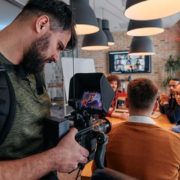
Training Video Production in Melbourne: Making Training Stick

Ask three people in your organisation how to do the same task and you will get three different answers. Training is where that starts. A new starter gets a thorough induction in March and a rushed one in August. A compliance briefing lands in the room and never reaches the people who were on leave.
Training video ends that. You record the right way to do something once, with the people who know it best, and everyone who needs it sees exactly the same version, whether it’s their first day or their two hundredth.
What training video does for you
It makes your training consistent. The correct way to run a procedure or handle a difficult customer is on film, so it stops changing as it passes from person to person. In regulated environments you can also show exactly what your staff were taught.
It gives your experts their time back. Your best people are usually the ones delivering training, and every session costs you their real work. A video carries the repeatable part of that session, which leaves your experts free for questions and judgement calls, where they add the most value.
It reaches everyone. Shift workers, regional teams and mid quarter starters get the same material without anyone booking a room. Staff can rewatch a single step when they need it, which is how people learn a procedure on the job, and with captions the video still works on a noisy site floor or a phone with the sound off.
It can be updated. Film it in short modules and a changed step means replacing one clip, not re-running the whole program.
Where it works across industries
Healthcare and aged care. Clinical teams need to see technique, not read about it. Hand hygiene, patient handling and equipment set up are all easier to show than describe, and a short video that staff can revisit before a shift often does more than a laminated checklist.
Construction and industrial. Site inductions and safety procedures are repeated constantly and the stakes are high. Filming on the actual site with the actual equipment makes the training specific enough to be taken seriously.
Government and councils. Policy changes, procurement rules and service standards have to reach large and varied teams in a consistent form. Video gives a department something it can roll out across sites and keep on record.
Education and registered training organisations. Practical skills are hard to teach through slides. Demonstration video lets trainers spend class time on practice and gives students a reference between sessions.
Retail, hospitality and professional services. Onboarding and product knowledge are the main uses. Where turnover is high, a strong onboarding video is one of the quickest ways to give new people a good first week without pulling existing staff off the floor.
Technology and software. Product training and internal tool rollouts work well as short, screen led videos with a real person guiding the viewer.
What makes people watch it to the end
Training video has a reputation problem, and it is mostly earned. The ones people actually finish share a few traits. They feature real people from your organisation, because colleagues are more believable than actors reading a script. They stay short and focused on one task, so a four minute video on a single procedure beats a forty minute recording of everything. And they are written to be scanned, with the key step stated plainly before it is demonstrated.
The best preparation is a short conversation about what the viewer should be able to do afterwards. If you can’t describe that in a sentence, the video isn’t ready to be made. It also helps to decide early how you will know it worked. That might be fewer repeated questions to your team, a faster ramp up for new starters or fewer errors on a particular task.
How we can help
At Zebra Vision we start with that outcome and the person who has to learn it, before anyone picks up a camera. We work out which parts of your training are stable and which are likely to change, so the structure suits future updates. Then we film with your own subject matter experts, on site or in a studio, and take care of the editing, graphics, captions and file formats so the finished modules drop into your intranet or learning platform without fuss.
We work with organisations across health, government, education, construction and not for profit, and we are comfortable in busy working environments where filming has to fit around the day. Our corporate video work covers the same range, and if budget is your first question, our guide to what corporate video production costs in Melbourne explains what moves the price.
If you are planning a training rollout and want to talk through what to film, get a quote. A short conversation is usually enough to sketch out the modules and a realistic budget.